
SEO Specialist for Small Businesses: How to Choose the Right Expert for Google Rankings
A practical guide to finding the right SEO specialist, improving content optimization, and building a stronger search presence for your business.
Introduction
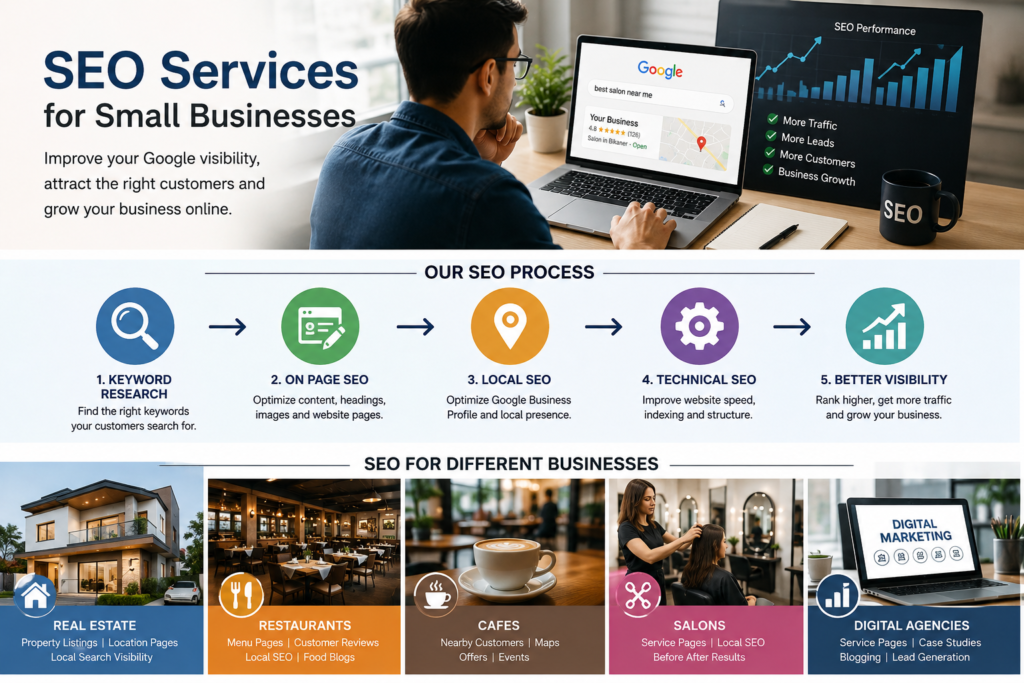
Getting a business website online is only the first step. The harder part is helping the right people discover it through Google. This is where an experienced SEO specialist can make a meaningful difference.
For a small business, SEO is not simply about adding keywords to pages. It involves understanding what customers search for, improving website structure, creating useful content, fixing technical problems, and building trust around the business.
For example, imagine a local salon that has a good website but receives very few visitors from Google. The owner may assume that the website needs more pages. In reality, the problem could be poor local optimization, weak service pages, slow loading speed, or content that does not match what potential customers are searching for.
A good SEO specialist looks at the complete picture before recommending changes. That approach is particularly useful for small businesses because every marketing decision needs to have a clear purpose.
Table of Contents
What Does an SEO Specialist Actually Do?
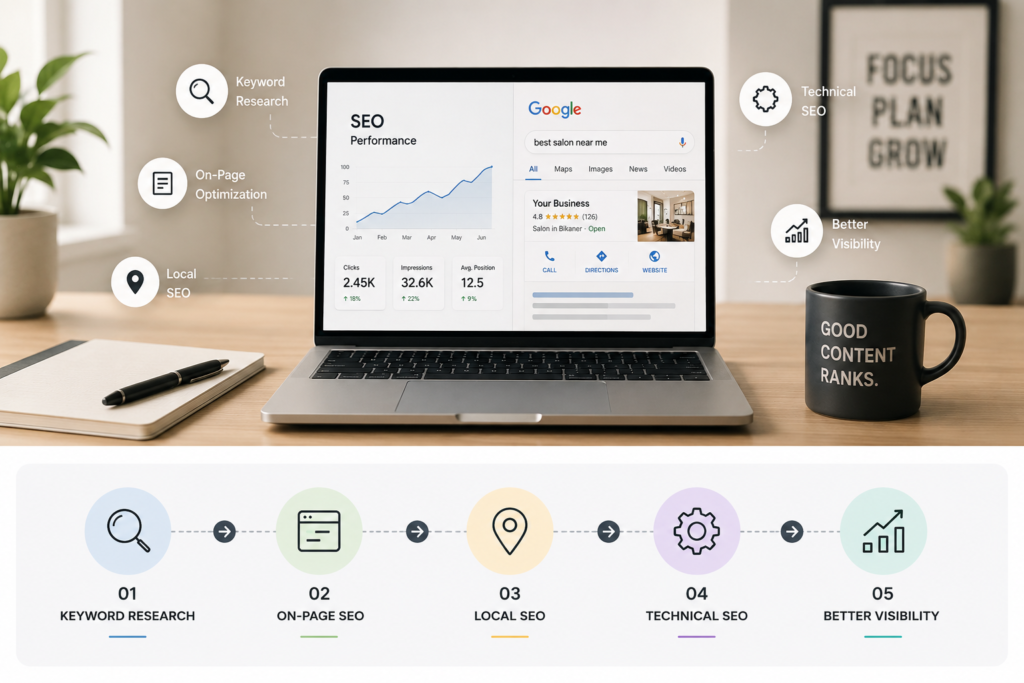
An SEO specialist works on different areas of a website to improve its ability to appear in relevant search results.
The work can include:
- Keyword research
- Search intent analysis
- On page SEO
- Technical SEO
- Local SEO
- Content optimization
- Internal linking
- Website structure
- Search Console analysis
- Competitor research
- Performance monitoring
The important point is that SEO is not one single activity.
A local restaurant, real estate professional, online store, and digital service provider can all need different SEO strategies. An SEO specialist should therefore begin by understanding the business, its customers, its competitors, and its current website performance.
A practical example
Suppose a local interior designer wants to attract customers searching for interior design services in their city.
Creating a page filled with the phrase “interior designer” repeatedly will not automatically produce good rankings.
Instead, an SEO specialist may identify related searches such as local interior design services, home interior design, kitchen design, residential interior designer, pricing related searches, and location based queries.
The website can then be structured around genuine customer needs.
Why Small Businesses Need SEO
Large companies can spend heavily on advertising. Small businesses often need a more sustainable way to attract relevant visitors.
That is one reason an SEO specialist can be useful for a small business.
Organic search can help businesses reach people who are already looking for a product, service, solution, or local provider.
However, SEO should not be treated as an instant traffic solution. Search visibility normally develops through consistent improvements.
A sensible strategy focuses on:
- Relevant search terms
- Helpful website content
- Strong service pages
- Local visibility
- Technical health
- User experience
- Business credibility
The goal is not simply to bring more visitors. The goal is to attract visitors who have a genuine reason to contact or buy from the business.
How an SEO Specialist Improves Google Rankings
Google uses many signals to determine which pages should appear for a particular search.
An SEO specialist cannot guarantee a specific ranking position because search results can change based on competition, location, search intent, website quality, and many other factors.
Instead, the specialist should improve the factors that the business can reasonably control.
1. Keyword and search intent research
Keywords help identify what people are looking for.
But understanding intent is even more important.
Someone searching for “what is local SEO” is looking for information. Someone searching for “local SEO services near me” may be looking for a provider.
An SEO specialist should understand this difference before creating or optimizing a page.
2. Better website structure
Search engines need to understand how different pages relate to each other.
A logical structure may include:
Home page → Service pages → Supporting articles → Contact page
Internal links can then connect related information naturally.
3. Local SEO
For a local business, location can strongly influence search visibility.
An SEO specialist may review the business profile, location information, service areas, local landing pages, business details, reviews, and other relevant local signals.
Content Optimization and Search Intent
Good content should answer a real question or solve a real problem.
This is where content optimization becomes important.
An SEO specialist should not simply increase the number of keywords on a page. Instead, the content should be organized around the reason someone searched for that topic.
For example, a page targeting “website development services” could explain:
- What website development includes
- Who needs the service
- Typical project stages
- Important technical considerations
- Questions clients should ask
- Factors that affect project cost
- How maintenance works
This gives the reader useful information while also giving search engines clearer context.
A useful content optimization approach
Before publishing an article, ask:
- Does the page answer the main search question?
- Is the information easy for beginners to understand?
- Are related topics covered naturally?
- Are headings descriptive?
- Are important internal links included?
- Does the page provide something genuinely useful?
An SEO specialist should be able to explain why each major content change is being made rather than simply providing a list of keywords.
How to Choose the Right Website Development Company
Do not select a website development company only because its portfolio looks impressive.
Look at the complete process.
1. Check relevant experience
Review websites created for businesses similar to yours. A company familiar with local businesses may better understand service pages, location information, enquiry forms, and local SEO requirements.
2. Ask about the platform
Ask whether the website will use WordPress, custom development, or another platform. The right option depends on your budget, technical requirements, and how much control you want after launch.
3. Discuss SEO requirements
If SEO is important for your business, discuss website structure, page speed, URLs, headings, image optimisation, and internal linking before development starts.
4. Understand ownership
Make sure you know who owns the domain, hosting account, website files, premium themes, plugins, and other important assets.
5. Ask about future support
Find out what happens if the website stops working or requires an update after launch.
SEO Development and Website Performance
SEO development connects search optimization with the technical side of a website.
A technically weak website can make it harder for search engines and visitors to use the site effectively.
An SEO specialist may work with a developer to review areas such as:
- Mobile usability
- Page loading performance
- Website architecture
- Broken links
- Redirects
- Indexing problems
- XML sitemap
- Canonical settings
- Structured data
- HTTPS
- Core Web Vitals
Technical SEO does not mean making a website complicated.
In fact, the best SEO specialist often recommends simple improvements that make the website easier for both users and search engines to understand.
Finding SEO Services for Your Business
When finding SEO services, avoid choosing a provider only because they promise fast rankings.
A responsible SEO specialist should explain the strategy, expected process, reporting method, and limitations clearly.
Before hiring someone, ask:
| Question | Why It Matters |
|---|---|
| What will you check first? | Shows whether they follow an audit based process |
| Which keywords will you target? | Helps confirm relevance |
| How will you measure progress? | Shows whether results are being tracked properly |
| What type of content will you create? | Reveals the quality of the strategy |
| How often will you report? | Creates accountability |
| What happens if rankings change? | Shows how realistic their approach is |
When finding SEO services, also check whether the provider understands your industry and location.
A strategy that works for an online store may not be suitable for a local dentist, restaurant, property consultant, or home service company.
Common SEO Mistakes Small Businesses Make
Many small businesses unknowingly create problems that slow their SEO progress.
Publishing content without a clear purpose
Writing several articles every month does not automatically create authority.
Each article should have a clear audience and search intent.
Using the same keyword repeatedly
Keyword stuffing can make content difficult to read.
An SEO specialist should prioritize natural language and topical relevance instead.
Ignoring service pages
Businesses sometimes focus heavily on blogs while their main service pages contain very little useful information.
Service pages are often directly connected to commercial search intent, so they deserve careful optimization.
Expecting immediate results
SEO requires patience.
A new website competing against established businesses may need time to build visibility.
A trustworthy SEO specialist should explain this instead of making unrealistic promises.
How to Choose the Right SEO Specialist
Choosing an SEO specialist should involve more than checking a portfolio.
Look for someone who can explain SEO in language you understand.
A good specialist should be comfortable discussing:
- Your business goals
- Target customers
- Search intent
- Existing website problems
- Competitor visibility
- Content strategy
- Technical improvements
- Measurement and reporting
Experience matters, but transparency matters too.
Ask for examples of previous work where possible. Look at whether the examples demonstrate actual business improvement rather than only ranking screenshots.
A strong SEO specialist will also tell you when an SEO recommendation is unnecessary. Not every website needs hundreds of articles or complicated technical changes.
Practical SEO Checklist
Before investing in SEO, make sure these basics are covered:
- Define your main business services.
- Identify your most relevant customer searches.
- Review competing websites.
- Improve important service pages.
- Create useful supporting content.
- Check mobile usability.
- Fix broken pages and links.
- Improve internal linking.
- Keep business information consistent.
- Monitor Google Search Console.
- Track relevant organic traffic.
- Measure enquiries and conversions.
This checklist gives a small business a useful starting point before finding SEO services or hiring an SEO specialist.
Frequently Asked Question?
An SEO specialist improves different parts of a website to help relevant pages become more visible in search results. This can include keyword research, content optimization, technical SEO, local SEO, website structure, internal linking, and performance analysis.
Hiring an SEO specialist can be useful when a small business depends on Google visibility but does not have enough SEO knowledge or time internally. The value depends on competition, website quality, business goals, and the strategy being followed.
There is no fixed timeline for SEO results. A website with an existing search presence may improve sooner than a new website. Competition, content quality, technical SEO, website authority, and search demand can all affect the timeline.
Content optimization means improving a page so it clearly satisfies the user's search intent while remaining useful and easy to read. It can include better headings, topic coverage, internal links, keyword placement, structure, and factual information.
SEO development refers to technical website improvements that support search visibility and usability. It can include website structure, indexing, mobile performance, redirects, structured data, page speed, and other technical SEO elements.
When finding SEO services, check the provider's process, communication, reporting, experience, understanding of your industry, and approach to content and technical SEO. Be careful with providers that guarantee specific Google rankings.
Conclusion
A successful SEO strategy is not built by repeating keywords or chasing every new search trend.
The role of an SEO specialist is to understand how people search, how search engines interpret websites, and where a business can realistically improve.
For a small business, the strongest approach is usually practical. Start with the website foundation, improve important service pages, create useful content, address technical problems, and measure meaningful results over time.
Whether you are considering an SEO specialist for your own business or are currently finding SEO services, focus on clarity and evidence. The right professional should be able to explain what needs to change, why it matters, and how progress will be measured.
SEO works best when it supports the actual business rather than existing only as a ranking exercise.
