
SEO vs Digital Marketing: What Is the Difference and Which One Does Your Business Need?
A simple guide for small businesses, real estate professionals, social media users, and students.
Introduction
If you promote a business online, you may often see SEO and digital marketing used as if they mean the same thing. They are connected, but they are not identical. Understanding SEO vs digital marketing can help you decide which online marketing activities are most suitable for your business goals.
For example, a real estate business may need SEO to appear in Google searches, social media marketing to build trust, and paid advertising to generate quicker enquiries. Each channel has a different purpose, but they can work together as part of one strategy.
The easiest way to understand SEO vs digital marketing is to remember that SEO is a specific online marketing discipline, while digital marketing is a much broader approach that can include several different channels.
This guide explains SEO vs digital marketing in simple language, with practical examples for small businesses, real estate professionals, service providers, and students.
Table of Contents
What Is SEO?
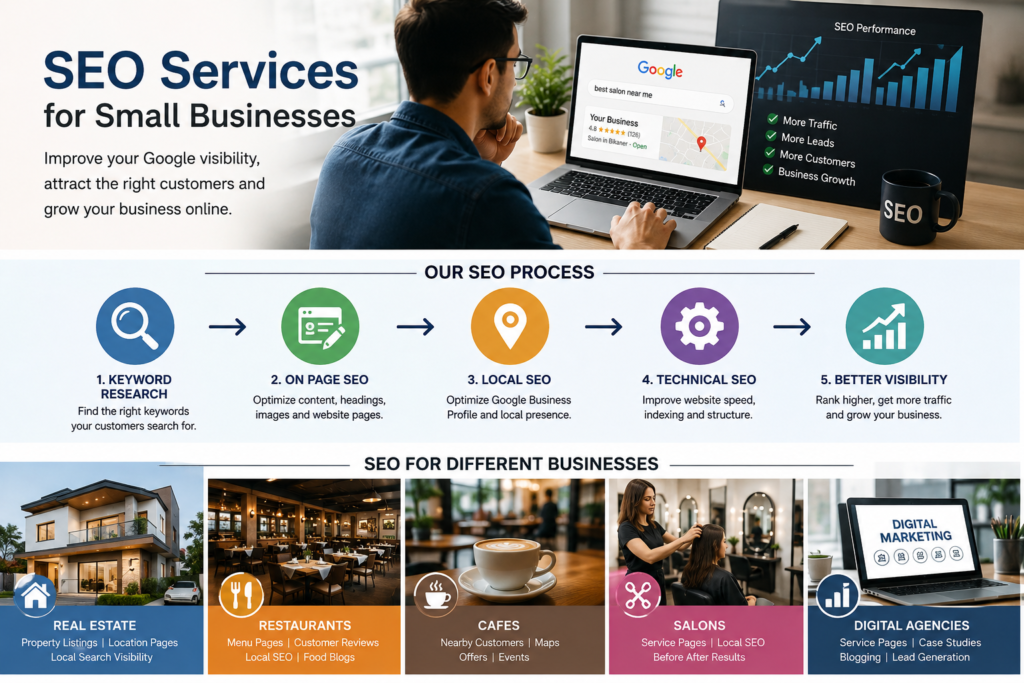
Search Engine Optimization, commonly called SEO, is the process of improving a website and its content so that it has a better chance of appearing in unpaid search engine results.
SEO can include:
- Keyword research and search intent
- Useful and relevant website content
- Page titles and headings
- Internal linking
- Technical and mobile improvements
- Relevant backlinks
- Local SEO
- Google Business Profile optimization
The primary focus of SEO is improving search visibility and attracting relevant organic traffic.
For example, imagine someone searches for “property dealer in Jaipur.” If a real estate website has useful content, strong local signals, relevant keywords, and a technically healthy website, SEO can help that business become easier for potential customers to discover.
What Is Digital Marketing?
Digital marketing is the broader process of promoting a business, product, service, or brand through digital channels.
It can include:
- SEO
- Social media marketing
- Content marketing
- Email marketing
- Paid advertising
- Influencer marketing
- Website marketing
- Online reputation building
This is one of the most important points when learning SEO vs digital marketing. SEO is one part of digital marketing, while digital marketing can involve multiple channels working toward different business objectives.
For instance, a salon could use SEO to attract people searching for salon services, Instagram to showcase hairstyles and customer results, email marketing to communicate offers, and paid advertising to reach a specific local audience.
Therefore, SEO vs digital marketing is not really about choosing between two completely separate activities. Instead, it is about understanding the role SEO plays within a larger digital marketing strategy.
SEO vs Digital Marketing: Key Differences
The simplest way to understand SEO vs digital marketing is to compare their scope, goals, channels, and methods.
| Factor | SEO | Digital Marketing |
|---|---|---|
| Scope | Specific digital marketing discipline | Broad online marketing approach |
| Main goal | Improve organic search visibility | Reach, engage, and convert audiences |
| Main channels | Search engines and websites | Search, social, email, ads, content, and more |
| Paid promotion | Primarily focused on organic visibility | Can include paid advertising |
| Example | Ranking for a local service search | SEO, social media, ads, email, and content |
The biggest difference in SEO vs digital marketing is scope. SEO mainly concentrates on search visibility, while digital marketing can use several online channels to attract and communicate with potential customers.
Another important difference is the way results are generated. SEO generally requires consistent optimization and content development over time. Digital marketing can also use paid channels that may generate traffic or leads more quickly.
How SEO Fits Into Digital Marketing
Think of digital marketing as a complete toolkit. SEO is one of the tools inside that toolkit.
Suppose you own a local salon. You could use SEO to attract people searching for salon services, Instagram to show your latest work, and paid advertising to promote a seasonal discount.
In this situation, SEO supports the larger digital marketing strategy rather than competing with it.
This is why SEO vs digital marketing should not be treated as a choice where one automatically replaces the other. Different channels can support different stages of the customer journey.
For example, someone may discover your business through Google, visit your website, check your Instagram profile, read customer reviews, and finally contact you. Several digital touchpoints can influence that decision.
A useful approach is to connect these channels. An SEO blog can be converted into a social media post, while a common social media question can become a detailed website article.
This makes SEO vs digital marketing more about coordination than competition.
Practical Examples of SEO vs Digital Marketing
Local Business
A bakery can use local SEO to appear when people search for cakes, bakery services, or birthday cakes nearby. Instagram can display products and customer orders, while paid advertising can promote special offers.
Here, SEO helps with search visibility, while other digital marketing channels support awareness, engagement, and conversions.
Real Estate Business
A real estate company can publish useful pages about property prices, locations, buying guides, projects, and frequently asked questions.
SEO can help attract people actively searching for property information. Social media can showcase properties and projects, while paid advertising can help reach people based on location and interests.
This is a practical example of how SEO vs digital marketing works in a real business environment.
Student or Beginner
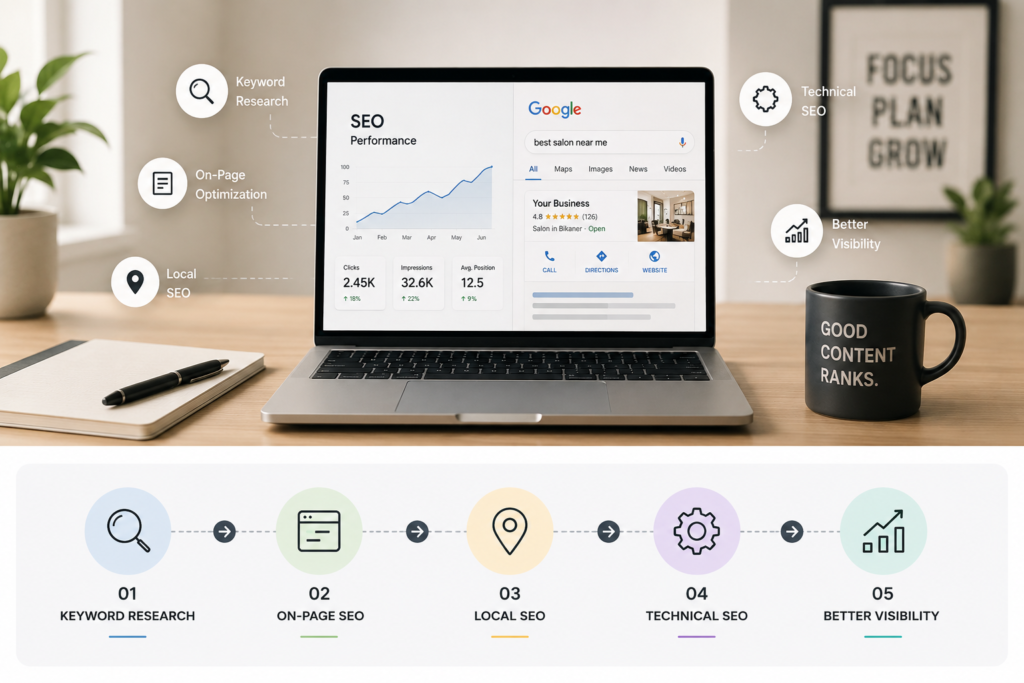
If you are learning digital marketing, starting with SEO can help you understand important concepts such as keyword research, search intent, on-page optimization, content structure, internal linking, and website performance.
After learning these fundamentals, you can explore social media marketing, paid advertising, email marketing, analytics, and content marketing.
Understanding SEO vs digital marketing becomes much easier when you learn how each channel contributes to a different part of the customer journey.
Common Mistakes to Avoid
One common mistake is treating SEO and digital marketing as interchangeable terms. Their scope and purpose are different.
Avoid these mistakes:
- Expecting SEO results immediately
- Choosing keywords only because they have high search volume
- Creating content without understanding the target audience
- Running advertisements without tracking conversions
- Writing content only for search engines
- Ignoring mobile usability
- Trying to use every marketing channel at the same time
Another mistake is focusing only on rankings. Rankings can be useful indicators, but they are not the final business goal.
Good marketing should ultimately help a business attract relevant visitors, enquiries, leads, sales, or other meaningful outcomes.
That is why the discussion around SEO vs digital marketing should always come back to the business objective rather than simply comparing the names of the two approaches.
Which Approach Should You Choose?
The right choice depends on your business, audience, competition, budget, and goals.
Choose SEO when:
- Your customers actively search for your products or services
- You want to build organic visibility
- You are willing to invest in long-term content and website improvements
- Local search visibility is important to your business
Choose a broader digital marketing strategy when you need several channels such as social media, content, email, paid advertising, and SEO.
For many small businesses, a focused combination can work well. Start by building a useful website, improving basic SEO, publishing helpful content, and using one social media platform where your target audience is active.
This balanced approach is often more practical than trying to decide between SEO vs digital marketing as though only one can be used.
If you are considering SEO services, look beyond promises about rankings. Ask what business outcomes the service is designed to support. Relevant organic traffic, enquiries, leads, conversions, and audience quality can be more meaningful than rankings alone.
How SEO and Digital Marketing Can Work Together
SEO and digital marketing can complement each other when they are planned around the same business goals.
For example, a business can publish an SEO-focused article targeting a useful search query. That article can then be shared on social media, included in an email newsletter, and supported with paid promotion when appropriate.
The data from one channel can also help improve another. Questions people ask on social media can provide ideas for new website content. Search data can reveal topics that deserve social media posts.
This is another reason SEO vs digital marketing should be viewed as a relationship between a specific discipline and a broader marketing system.
Instead of asking which one is better, ask:
What does my business need right now?
That question makes it easier to select the right combination of marketing activities.
Frequently Asked question?
SEO mainly focuses on improving organic search visibility. Digital marketing is broader and can include SEO, social media, content marketing, email marketing, paid advertising, and other online channels.
Yes. SEO is an important part of digital marketing. A business can combine SEO with other suitable channels depending on its goals and target audience.
Neither is automatically better. SEO is useful for organic search visibility, while broader digital marketing can help a business reach customers through multiple channels. The right choice depends on your business objective.
Yes. A small business can start with SEO when potential customers actively search for its products or services. Other digital marketing channels can be added as the business grows.
There is no fixed timeline. Competition, website quality, content, technical health, authority, search demand, and consistency can all influence SEO results.
They can be useful when customers search online for local products or services. Local SEO can help improve visibility for relevant location-based searches.
Yes. SEO can work alongside social media, content marketing, email marketing, paid advertising, and other digital channels. Combining suitable channels can create a more complete online marketing strategy.
Conclusion
Understanding SEO vs digital marketing helps you make better decisions about where to invest your time, effort, and marketing budget.
SEO focuses primarily on organic search visibility, while digital marketing covers a wider range of online channels. SEO can therefore be an important part of a broader digital marketing strategy rather than a completely separate alternative.
For a local business, real estate company, service provider, or beginner learning marketing, the right strategy should depend on your goals, audience, competition, and available resources.
Once you understand SEO vs digital marketing, it becomes easier to identify which channels deserve your attention and how different marketing activities can work together.
The goal is not to use every channel. The goal is to choose the channels that help your audience discover, trust, and ultimately engage with your business.
